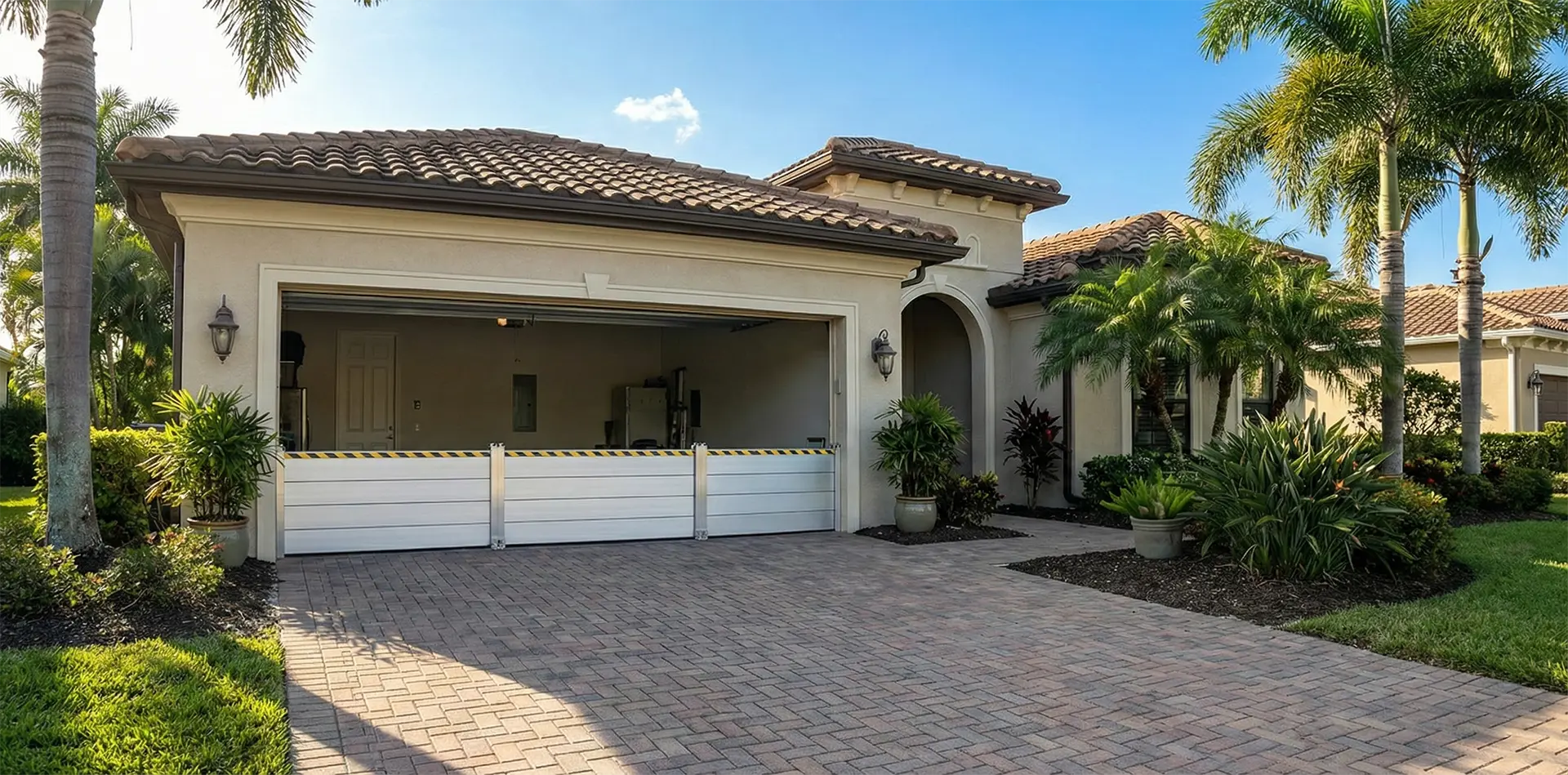
The aluminum panel-and-post flood barrier market is exploding. But a tangle of federal rules, local ordinances, and insurance incentives is creating a perfect storm of confusion for the homeowners who need protection most.
After Hurricane Ian carved a path of destruction through Southwest Florida in 2022, followed by Helene and Milton in quick succession, homeowners across the Gulf Coast and beyond began asking the same urgent question:
What can I actually do to protect my home?
Increasingly, the answer has been the aluminum panel-and-post flood barrier system. Products like Aqua-Cade™ and similar engineered systems from a growing roster of manufacturers have surged in popularity.
These systems use extruded aluminum planks that slot into permanently mounted stainless steel or aluminum posts around doorways, garage openings, lanais, and windows. EPDM rubber gaskets create a tight seal, and compression hardware locks everything into place. The barriers can be deployed in minutes and stacked to heights of six feet or more.
The appeal is obvious:
- Lightweight and reusable
- Corrosion-resistant
- Far more effective than sandbags
- Compact storage
- Engineered protection that matches high-value coastal properties
But here’s the problem: the regulatory framework governing these systems was never designed for them.
And that’s where the tension begins.
The NFIP’s Residential Blind Spot
To understand the issue, you have to start with FEMA’s National Flood Insurance Program (NFIP).
One regulation surprises most homeowners: dry floodproofing is not permitted for residential buildings under the NFIP.
Under NFIP rules:
- Only new or substantially improved non-residential buildings in A Zones can have their lowest floor below Base Flood Elevation if certified as dry floodproofed.
- Residential dry floodproofing below BFE is not permitted (with limited exceptions).
- Dry floodproofing is completely prohibited in Coastal High Hazard Areas (Zone V).
These rules were written decades ago. The reasoning? FEMA assumes residential occupants may not reliably deploy and maintain active flood protection systems the way commercial building managers would.
The consequences are significant.
If a homeowner invests $15,000–$40,000 in a high-end aluminum barrier system:
- It does not reduce NFIP flood insurance premiums.
- It does not count toward FEMA floodproofing certification.
- It may still require permits that local building departments aren’t fully equipped to evaluate.
The system may be engineered and professionally installed, but the insurance framework effectively ignores it.
Municipalities: Stuck in the Middle
Floodplain management is enforced at the local level, but governed by federal standards.
Communities participating in the NFIP must adopt flood damage prevention laws and enforce construction standards in mapped flood hazard areas. If they fail to enforce FEMA’s minimum standards, they risk losing NFIP participation. That would mean every property owner in the community loses access to federally backed flood insurance.
So when a homeowner brings engineered plans for a barrier system to a building department, the floodplain administrator faces a dilemma:
- The system may be well designed.
- The manufacturer may claim FEMA compliance.
- But NFIP regulations don’t provide a clear pathway for crediting residential dry floodproofing.
Administrators must determine:
- Does this installation count as “development” in the floodplain?
- Is a floodplain development permit required?
- What engineering standards apply?
- Will FEMA auditors question the decision later?
Many municipalities are responding in one of three ways:
- Permit the installation, but provide no insurance credit.
The most common approach. Homeowners get protection, but premiums don’t change. - Require engineering certification anyway.
Some cities require PE-stamped plans, emergency operation procedures, and maintenance documentation; mirroring commercial dry floodproofing standards. - Discourage or quietly block installations.
In risk-averse communities, homeowners are told systems “aren’t allowed,” even though FEMA does not prohibit homeowners from adding protection, it simply does not credit them under NFIP.
This ambiguity creates friction, confusion, and inconsistent enforcement from city to city.
The Standards Gap
Complicating matters further is the issue of product standards.
ANSI adopted FM Approval Standard 2510 for flood abatement equipment in 2014. But it was primarily designed for large, freestanding perimeter flood barriers used in commercial or infrastructure applications—not building-mounted aluminum panel-and-post systems.
Meanwhile, the residential market is booming.
Some manufacturers use:
- 6063-T6 anodized aluminum
- Marine-grade stainless steel
- Engineered EPDM sealing systems
Others use thinner-gauge imports and lower-grade materials.
The difference between those two approaches can determine whether a barrier holds (or fails) during storm surge.
The testing and certification landscape has not fully caught up with the residential demand curve.
Where This Is Heading
Several forces are converging that will likely intensify this issue.
Federal disaster funding is tightening. Insurance markets are retreating from high-risk coastal zones. NFIP premiums are rising under Risk Rating 2.0. Private insurers are exiting markets entirely or dramatically increasing deductibles.
At the same time, the flood barrier market is expanding rapidly, with new vendors entering the space and making aggressive claims.
HUD’s Federal Flood Risk Management Standard is pushing federally funded housing toward higher elevation and resilience requirements, increasing construction costs and making retrofit solutions like barrier systems more attractive for existing homes.
The likely near-term outcome is a patchwork regulatory approach.
Some municipalities will develop model ordinances and structured permitting standards. Others will lag. Homeowners will continue navigating a maze of rules that don’t fully align with modern flood barrier technology.
What Homeowners Should Know Right Now
If you’re considering an aluminum panel-and-post flood barrier system, here’s the reality.
You absolutely can install one. No FEMA regulation prohibits homeowners from adding flood protection to their property.
But:
- It likely will not reduce your NFIP premium.
- Your municipality may require floodplain development permits.
- Engineering standards may vary locally.
Most importantly: quality matters.
Look for systems built with:
- 6063 T5 or T6 aluminum
- EPDM sealing systems
- Marine-grade stainless steel hardware
- Engineer-certified designs
Even if FEMA does not require commercial-level certification for your home, building to that standard protects you physically—and demonstrates due diligence to future insurers and buyers.
Before purchasing:
- Contact your local floodplain administrator.
- Ask what permits are required.
- Ask what standards will be applied.
- Determine whether they have prior experience with these systems.
If they don’t, be prepared to educate them. This category of protection is not going away.
The Bottom Line
The aluminum panel-and-post flood barrier market is accelerating.
Climate risk is increasing. Insurance availability is shrinking. Federal disaster funding is tightening.
But FEMA’s regulatory framework has not evolved fast enough to fully accommodate residential dry floodproofing systems.
That gap is where municipalities, homeowners, and manufacturers are all feeling the squeeze.
This article is for informational purposes only and does not constitute legal, engineering, or insurance advice. Consult with a licensed professional engineer, your local floodplain administrator, and your insurance agent before making flood mitigation decisions for your property.